
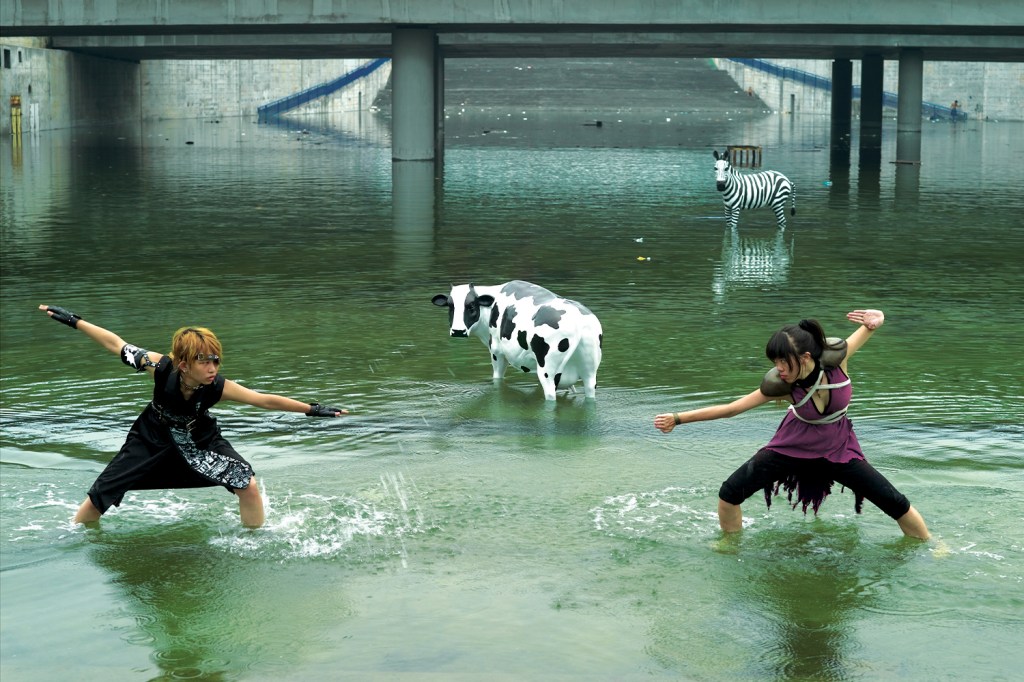
Cao Fei is a Chinese multimedia artist. Her work is set in the aftermath of the Chinese Cultural Revolution.
Fei blends surrealism, social commentary, pop culture, and documentary in her films and installations. With this variety of techniques and subjects, she examines how rapid sociocultural transformation affected daily Chinese lives.
One consequence of this transformation was access to media from the rest of the world. As a young artist, Fei was interested in global pop culture—Cantonese music, Japanese anime, American hip-hop—and multiplayer video games! One of these games was Second Life, a virtual world whose simulated economy was the perfect stage for artistic experimentation. Using the game, Fei has recreated and re-interpreted the Chinese economy, historic sites, and political scene.
Similarly, Fei is interested in using digital tools to tap into people’s subconscious personalities, dreams, and desires. She seems to ask: “If you could reimagine yourself as anything, what would you be?” Her own reimagined avatar, China Tracy, guides viewers into her artwork and encourages them to rethink their own place in the world.

An anonymous contributor states about Fei: “She says a lot about the way life is without telling you directly…instead, you’re left to experience it yourself in ways that touch your creativity.”
Ultimately, Fei’s efforts have made her renowned around the world. She has been exhibited at MomA, the Guggenheim Museum (New York), and the Tate Modern, London. She continues her work in the heart of Beijing, observing life around her with the intent of looking deeper than what is on the surface…
Discussion Questions
- Watch the video for RMB City (2007). The artwork features one of Fei’s city plans.
- What words would you use to describe the city in this video?
- Is these anything in the video that resembles something you’d see in real life?
- What doesn’t seem real in the video?
- How does Fei’s Chinese heritage appear in the video?
- Do you interact with any media from across the world (ex: K-Pop, Anime, etc.) Where is it from? What do you like about it?
- How has it affected you?
- How do you think it affected Cao Fei growing up?
- For those 18 and older: create an account on Second Life and play the game yourself. How do you think it affected Fei’s work?
- Compare Fei’s version of magical realism with Cassi Nomada. How do their approaches differ? How are they similar?
 THE LYCEUM
Leave a comment