
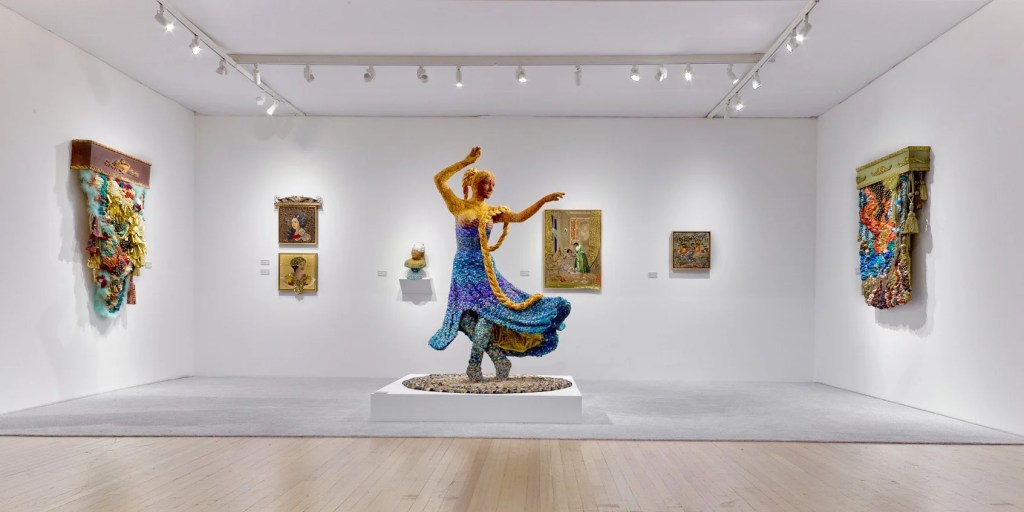
Suchitra Mattai is a Guyanese-American artist of South Asian descent. Her multi-disciplinary work examines, and unravels, existing historical narratives.
Mattai also embraces her distinct Indo-Caribbean heritage. Hoping that it strengthens her interaction with history, she specifically draws from her and her family’s experiences with colonization, migration, and gendered domesticity.
What does this look like? Oftentimes, it relates to the material Mattai employs. Her focus on women’s labor has led her to pursue embroidery, tapestry weaving, and fiberwork. These elements are commonly demeaned as “women’s work” in art historical scholarship, yet she transports them to the vaunted realm of fine art.
Mattai also seeks out vintage and found materials. She believes their rich pasts as objects can speak to our own pasts as humans. For example, her use of vintage saris in works connects women of the South Asian diaspora with their predecessors—the original creators of sari.
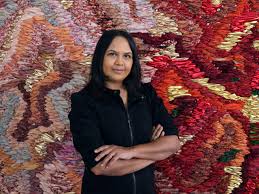
Mattai states: “Combining, re-contextualizing, and reconfiguring disparate materials is a way of making sense of the world around me and of embracing multiple cultural spheres that I inhabit as an Indo-Caribbean woman.”
Mattai’s materials are unconventional, yet inspiring for artists searching to break tradition. More than that, they are deeply personal to Mattai. Weaving together their many meanings creates a complex depiction of her history—one that she hopes can relate to others as they carry, in them, the generations of hope, joy, and hard work that all families experience.
Museum Walkthrough: Watch a clip of A Collective Horizon from the curator’s camera!
Discussion Questions
- Think about the certain types of materials Mattai uses to reflect her cultural or social identity (Indo-Caribbean, female, American).
- What materials would you use in your artwork, if you wanted to represent yourself?
- Watch the video of The Collective Horizon, or find another of Mattai’s tapestry works. How would you describe them to someone? Are they large or small? Colorful or monochrome?
- What might these features suggest about Mattai and her artwork?
- Read about the Milken Center for Advancing the American Dream here. What is significant about putting a work like The Collective Horizon in this building?
 THE LYCEUM
Leave a comment