
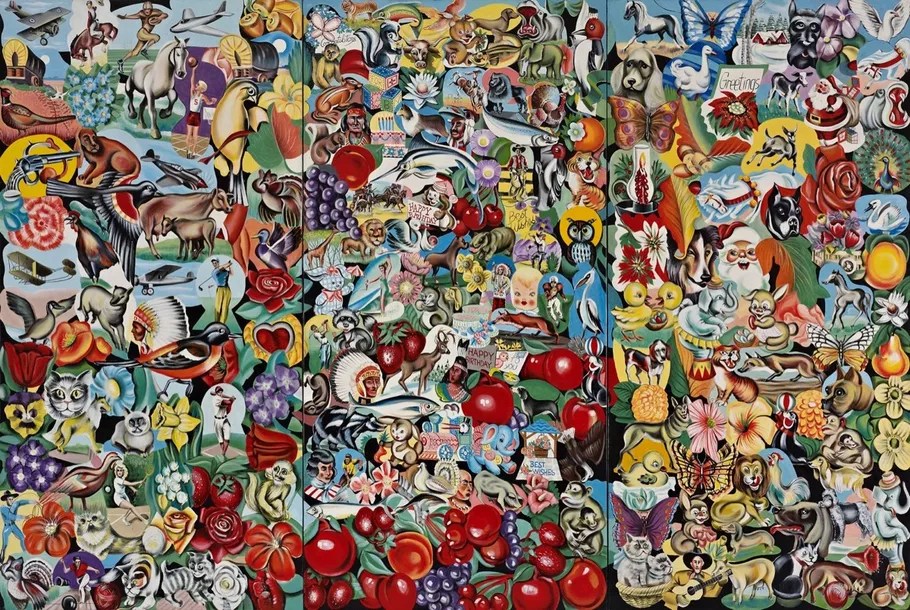
Erró (born Guðmundur Guðmundsson) is an Icelandic artist and filmmaker known for his involvement in pop art.
Despite adhering to the traditions of several artistic movements—pop art, Surrealism, Narrative Figuration—Erró’s work has its own distinct character and is difficult to confine to a single movement.
In fact, Erró seeks to cover every possible domain of art. He first gained prominence with his bright synthesis of advertisements, comics, and pop-culture posters, which appeared in both his paintings and famous collages. Since then, he has also produced experimental cinema, graphics, and performances. But what message does his variety of mediums communicate?
When he began work in the 20th century, Erró was one of the first Icelandic artists to recognize the consequences of a global society. He had, and still has, a critical and comedic eye. This eye watches for issues like consumerism, political propaganda, over-sexualization in media, and technologies that both increase our efficiency and obstruct our understanding as humans. It channels his opinions on these threats into art, displaying what they mean for both him and us as they enclose our vulnerable moments.
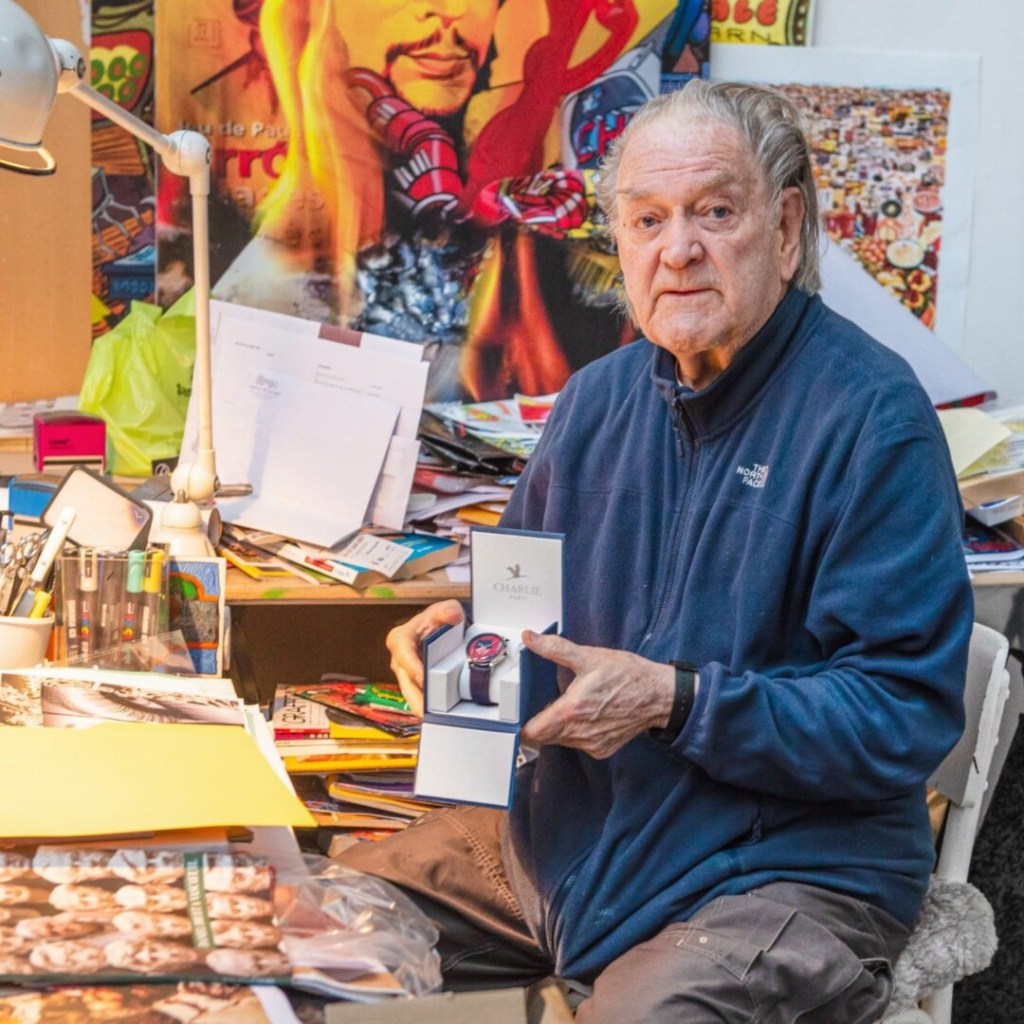
In their exhibit Erró: The Power of Images (2022), the Hafnarhús stated:
“Freely mixing and opposing images from different print sources and places, he has produced a dense, complex and often disturbing oeuvre, which breaks open cultural stereotypes and hierarchies…His original compositions articulate a flow of powerful visual narratives that covered the “world scene” long before the internet was invented and globalization became a common theme.”
Thus, Erró’s extensive saga of work is not to be underestimated! What might appear to be comic panels or silly ads are not so frivolous. Rather, they are a narrative of concern—enriched by Erró’s extensive experience and travel—and an expression of resistance against the authorities perpetuating the worst of a globalized world.
Museum Walkthrough: Watch 1001 Nights through the curator’s camera!
Discussion Questions
- Refer to Erró’s Foodscape in the selected works list. Before reading the description, describe the work of art in your own words. After you’re done, read the description and consider the following
- What features did you include in your description?
- How do they tie into the message of the work?
- Do you think Erró’s concerns about overconsumption in Western society are founded?
- Refer to the works of Roy Lichtenstein, a contemporary of Erró’s in the pop art scene. Then, compare Lichtenstein’s work to Erró’s Ghost Rider (in the selected works list).
- Would you classify Erró’s work as pop art based on this comparison?
- Why might it be problematic to confine artists in one category/movement, especially with a case like Erró’s?
 THE LYCEUM
Leave a comment