
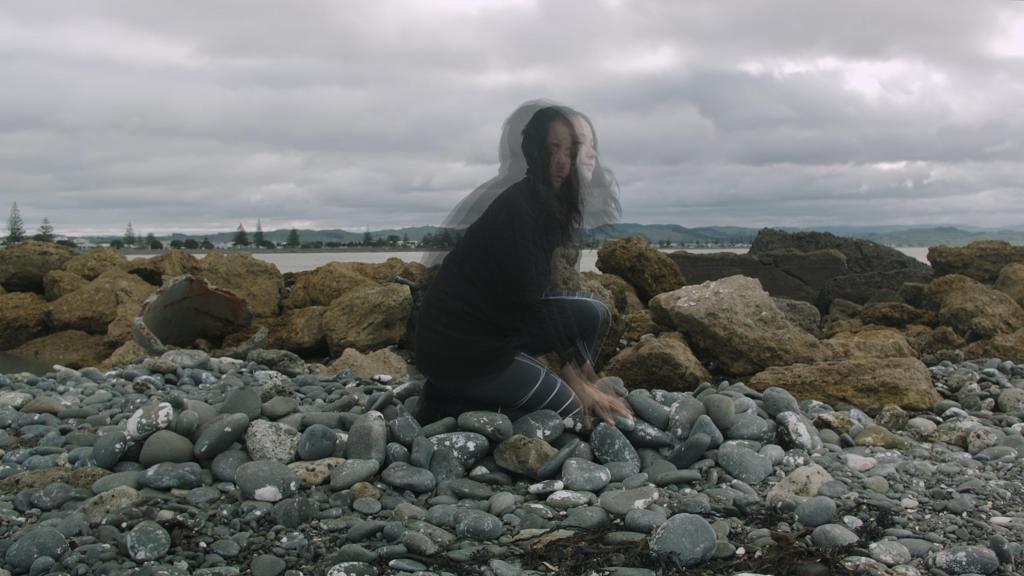
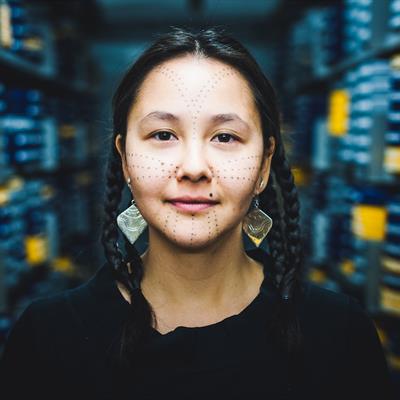
Asinnajaq is a Canadian Innuk artist, writer, filmmaker, and curator of Inuit art.
In her work, she highlights the importance of human rights, community, and indigenous perspectives in representing different forms of beauty.
How might these subjects come together in art? Like Cassi Nomada, the answer lies with the art historical canon, or the traditional body of artworks deemed important by art history scholars. However, it’s equally important to acknowledge that older versions of the canon are built upon Eurocentric and colonialist views.
During the colonial period, Europeans subjugated indigenous populations like the Inuit for political and economic gain. At the same time, they sought to destroy any means of indigenous sovereignty – including cultural expression. As a result, Inuit art has been historically overlooked in the canon. But Asinnajaq is turning the tide!
An anonymous worker at the Georgia Museum of Art states: “It’s an incredible opportunity to feature Asinnajaq’s work.
Asinnajaq has made substantial efforts to redefine arts spaces to tell new and interesting stories from a variety of communities. One example is her co-creation of Tilliranitt, an art festival for Inuit creators.
However, Asinnajaq’s work as an artist also testifies to the care and consideration she gives her own community. She teaches a valuable lesson about how art uplifts the people around us and the things we care about.“
Indeed, Asinnajaq’s work highlights the history, values, and personal importance of her Innuk community. With European colonization as a shadow, this history may not always be positive from a human rights standpoint, nor will these values be completely familiar to Western audiences. Yet seeing them through Asinnajaq’s eyes does away with prejudice – granting the story of her and her community a new and rejuvenating future.
Discussion Questions
- Watch Asinnajaq’s Three Thousand. Pay special attention to how the film is shot in three main segments, each of which feature distinct types of footage: archival footage, contemporary footage, and animated footage.
- How do these segments compare to one another in subject matter and tone? How did you respond to each individually?
- What is Asinnajaq sharing about the Inuit through the segments?
- Artist Kent Monkman depicted Asinnajaq as part of his Shining Stars series. Look at his portrait. What do the details suggest about Asinnajaq? Talk about the landscape, her pose, her expression, her clothing, or more.
- If you are interested in how this portrait relates to art history as a whole, some interesting starting points would be Kehinde Wiley’s A Maze of Power series and Rigaud’s Portrait of Louis XIV. Like Monkman, Kehinde Wiley uses the language of portraiture to portray indigenous leaders from Africa. But this language stems directly from European portraits like Rigaud’s.
- If you analyze each portrait separately, then compare them, an intriguing message about Eurocentrism through portraiture may emerge… one of respect, defiance, or both.
- If you are interested in how this portrait relates to art history as a whole, some interesting starting points would be Kehinde Wiley’s A Maze of Power series and Rigaud’s Portrait of Louis XIV. Like Monkman, Kehinde Wiley uses the language of portraiture to portray indigenous leaders from Africa. But this language stems directly from European portraits like Rigaud’s.
 THE LYCEUM
Leave a comment