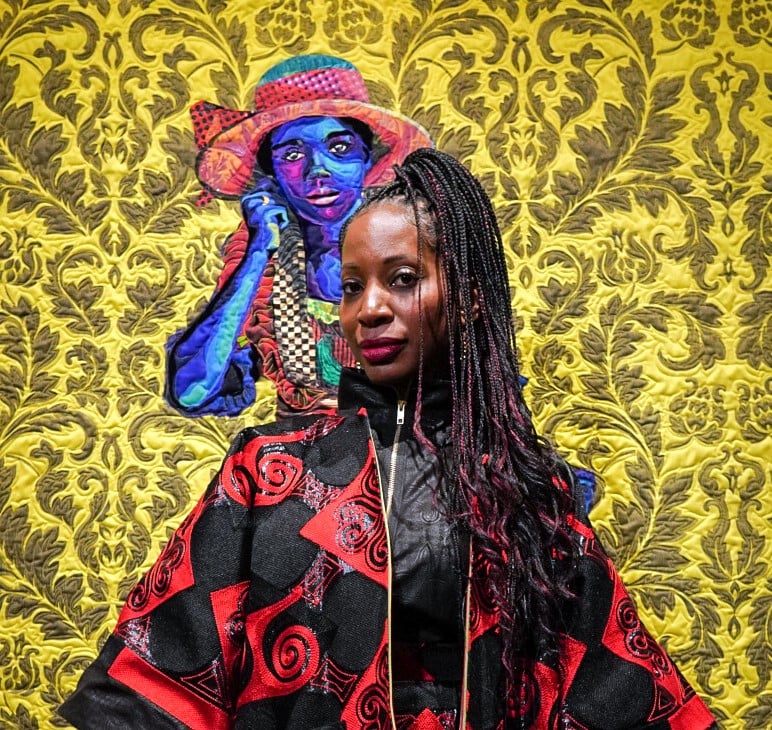
Butler is known for her revolutionary approach to quilting, transforming a formerly ‘craft’ medium to the realm of ‘fine art’.
Butler’s work stems from quilting traditions of African American communities. This tradition has a long and difficult origin; many African American women would quilt to supplement the little bedding they received in enslavement, protecting their families from the cold. However, quilting grew into an expression of agency, artistry, and resilience – even allowing families on the Underground Railroad to send coded messages.
Butler uses this tradition to explore what elements of both African and American heritage say about current-day Black America. In the past, she has used Ghanian, Nigerian, and South African fabrics to create her vivid portraits. In doing so, she has quilted for the Smithsonian, Epcot, and issues of the Time magazine.
Butler herself states: “All of my pieces are done in life scale to invite the viewer to engage in a dialogue….I am inviting a reimagining and a contemporary dialogue about age old issues, still problematic in our culture, through the comforting, embracing medium of the quilt. I am expressing what I believe is the equal value of all humans.”
Learn more about Butler from Amanda Richey, a teacher at Mount Pisgah!
Written Testimony from Amanda Richey
On Saturday, August 16, 2025, we asked Amanda Richey about the importance of Butler’s work.
“Well, first I think her work shows Black beauty and joy and importance in a way that other artists have not. She creates a real history of Blackness and her own Blackness in a way I have never seen. It makes me want to see and know more about that experience.”
“Secondly, I’m really quite enamored by her quits. I couldn’t fully appreciate them until I saw her exhibit at the art institute of Chicago. Her skill with textiles, color, layering, stitching…it’s really unbelievable. The honing of her artistry is beyond what you are prepared to see.”
“And maybe most importantly, I love how Butler’s work publicly elevates what has traditionally been viewed as a “woman’s craft project” to divine artwork. I once read a Gloria Steinem article in which she encouraged a shift in focus from traditional art objects (often produced by men) to art that reflects women’s experiences, challenges societal norms, and empowers individuals. Butler does all of those things.”
I Am Not Your Negro (2019): Inspired by vintage photographs, Butler quilts a bold-colored, bold-patterned man who gazes intently at the viewer. However, this challenge is levelled at America: has it lived up to its promises of freedom and equality?
The Storm, the Whirlwind, and the Earthquake (2020): Butler’s portrait of Frederick Douglass derives its name form one of Douglass’ speeches. Just like the speech, this portrait seeks to “rouse” and “startle” the conscience of the nation, exposing its hypocrisy against God and man.
Broom Jumpers (2019): This life-size quilt is taken from a 1930s photograph. Self-assured and engaging, the two individuals are set against African wax-print fabrics and flowers, suggesting their happiness. The title also refers to an older custom of Black Americans to jump over a broom, marking the end of their wedding.
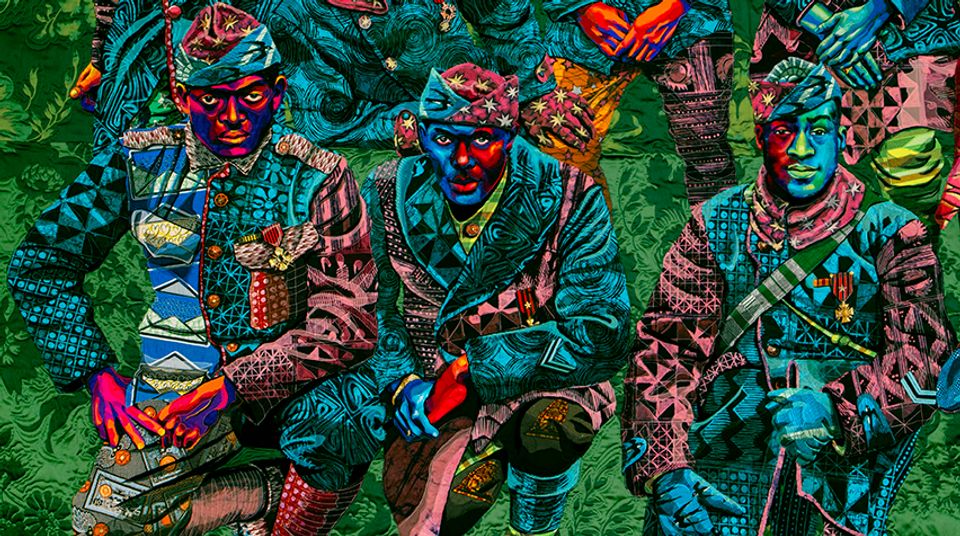
Bisa Butler’s Don’t Tread on Me, God Damn, Let’s Go! — The Harlem Hellfighters (2021-2022), courtesy of the Smithsonian American Art Museum.
Discussion Questions
How does Butler draw upon her distinct cultural identity to create art? Why do you think this is important?
Glance at one of Butler’s many portraits – find one yourself or look in the selected works list. On a visual level, what makes these portraits different from portraits you’re used to seeing?
What emotions do you think Butler evokes in her work? Draw from whatever sticks out to you – the colors, the subject, or the material. How does it make you feel?
This artist was submitted by Amanda Richey, Teacher at Mount Pisgah Christian School

 THE LYCEUM
Leave a comment